

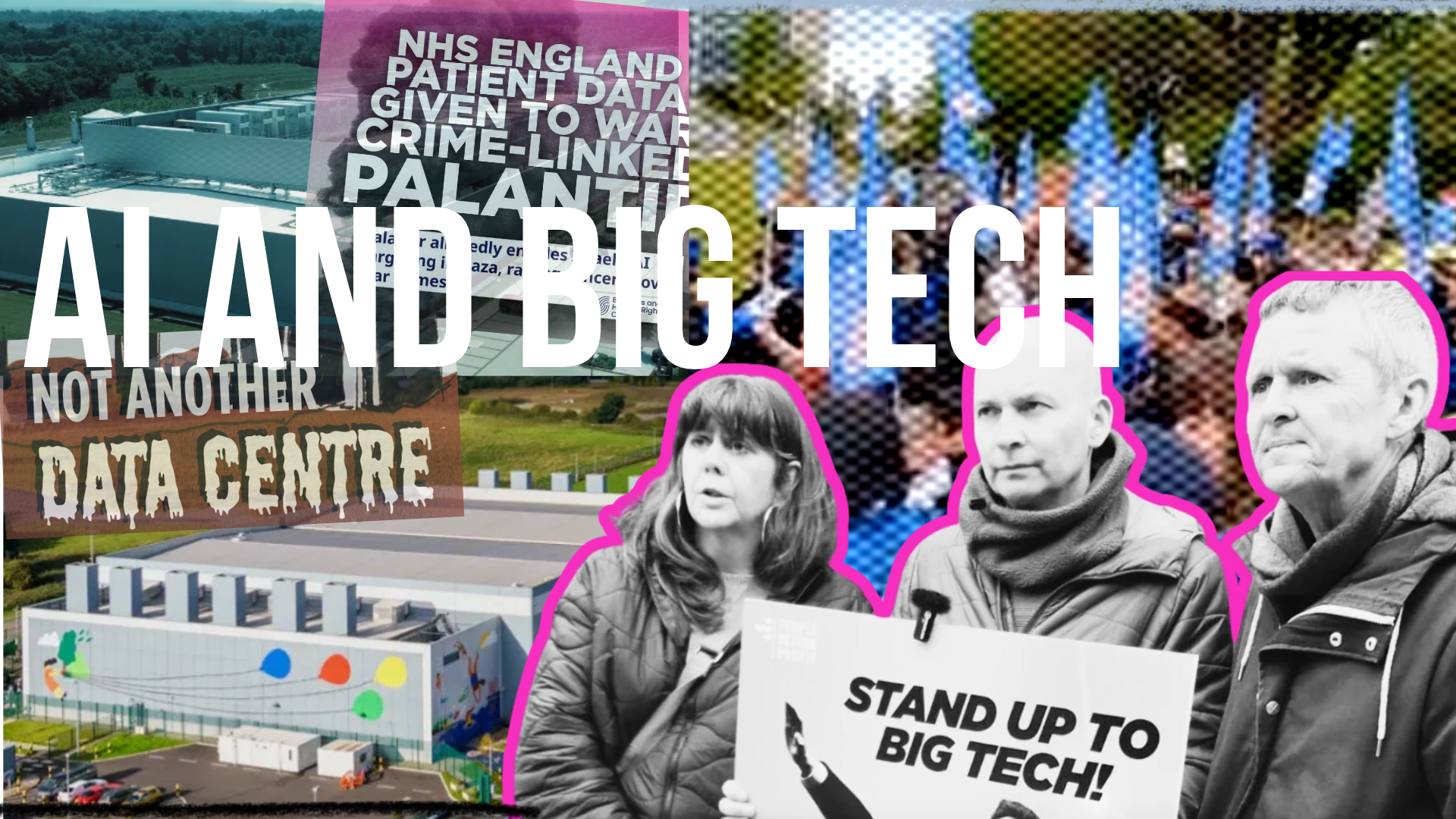
We are in the midst of an unprecedented global bubble with trillions of dollars being invested in unproven AI technologies. As the headquarters for so many big US tech and social media companies, Ireland is close to the epicentre of this bubble. It is very likely that there will be a massive global crash in the short to medium term and, as with the last crash, Ireland will be one of the countries worst affected.
AI and Data Centres
The AI bubble is accelerating the rate of climate collapse with the global energy demand of data centres projected to double by 2030. The impact of this is particularly severe in Ireland, where data centres already use 21% of our electricity supply. This is more than all the renewable energy created in recent years - which is desperately needed for essential purposes like housing and public transport.
AI threatens not just jobs, but risks peace, democracy, and life.
AI also threatens huge numbers of jobs. In jobs that are not displaced, AI will be used by capitalists and the state to reduce the autonomy of workers and increase the rate of exploitation. It will also be used as a weapon of war to intensify killing, as we saw in the genocide in Gaza, as well as in internal surveillance and repression of the sort offered by Peter Thiel’s Palantir.
Oppose Big Tech and AIPeople Before Profit should position itself now as leading the opposition to Big Tech and AI - which increasingly are viewed negatively by working-class people. Opinion polls have found that only 27% of Irish people have a positive view of AI, that 48% believe it will be a force for bad, and that Irish people have among the lowest levels of trust in AI in the world. This is despite the government’s pushing of AI in the public and private sectors and in education, its repetition of Big Tech’s propaganda that AI is the 'Fourth Industrial Revolution', and its promotion of Big Tech interests at national and EU level.
Profit Driving Toxic Social Media
The economic and environmental dangers of the AI bubble are not yet clear to most people but there is growing suspicion of AI and outright opposition to Big Tech’s pushing of toxic content, especially at children. Trillionaire Elon Musk and X/Grok have become a particular focus due to Grok’s involvement in image-based sexual abuse, including child sexual abuse imagery. This has added fuel to calls to ban social media for under-16s and limit access to smartphones. Rather than joining in this purely aged-focused approach, which allows AI and Big Tech to keep expanding and profiting from pushing toxic, misogynistic and far right, content at everyone else, we should turn the focus back onto the Big Tech companies.
Our Resolutions
- PBP should not use AI-created graphics and imagery and where possible we should discourage campaigns we are involved in from doing so.
- We should work within the trade unions and with others on the left for the development of trade union policies on the use of AI, to protect workers whose jobs may be affected, to protect whistleblowers, and to promote worker self-organisation and trade union rights within Big Tech companies. The Covalen strike shows the potential for workers’ action in these companies.
- We should call for Big Tech companies to be taken into democratic public ownership and turned into non-profit public services.
- We should seek to mobilise around demands such as:
- that toxic algorithms are turned off by default and completely for children.
- that Big Tech stops harvesting our personal data.
- the right to opt out from using AI, for workers and users of public services.
- that no state contracts are given to Big Tech companies using AI for the management of public services.
- that no more data centres are built or expanded.