

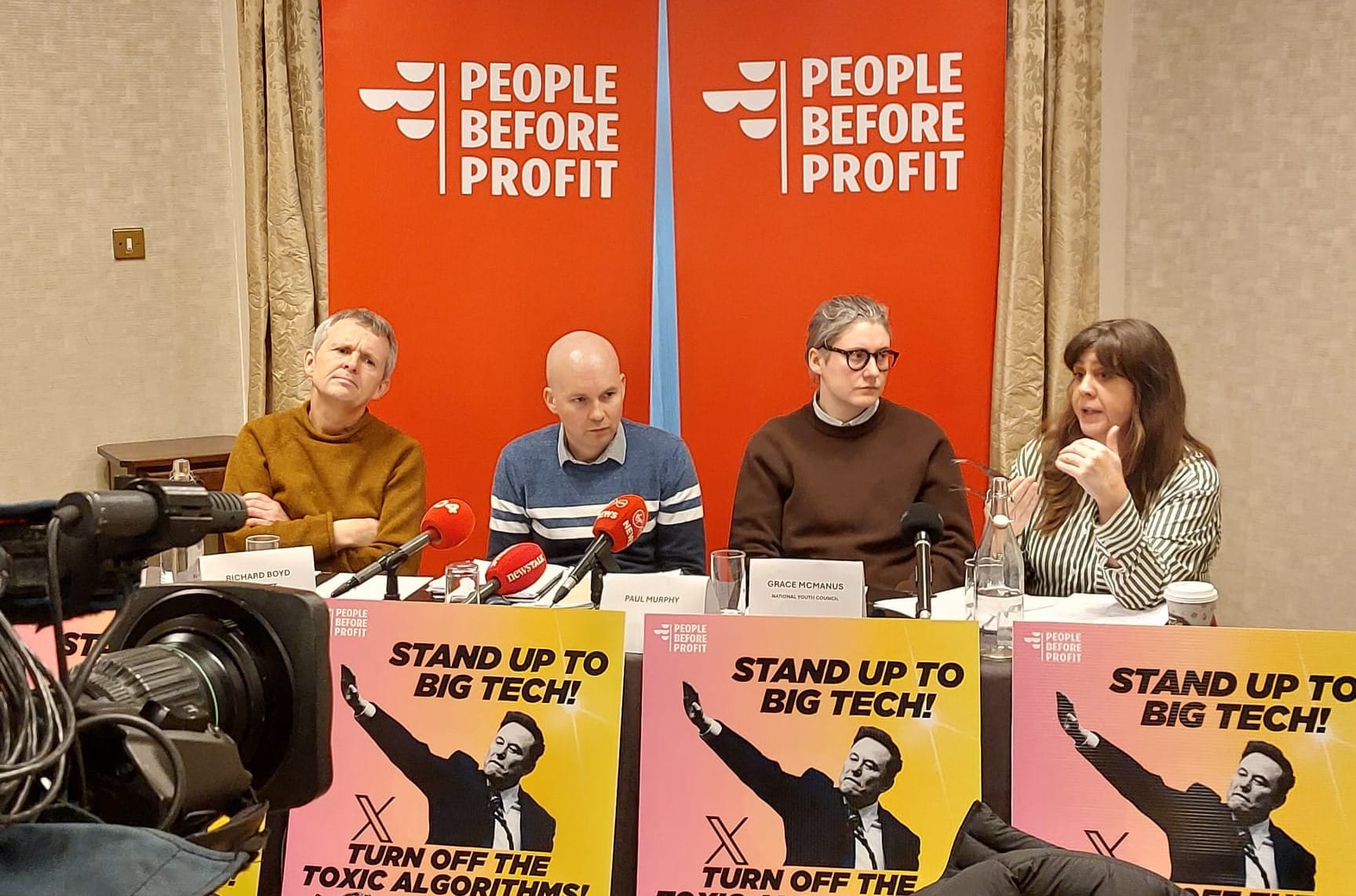
People Before Profit hosted a press conference this morning to launch its Online Safety (Recommender Algorithms) Bill 2025. The Bill would require social media platforms to turn off recommender algorithms for under 18s. It would also require that recommender algorithms based on profiling or sensitive personal data have to be actively turned on by adult users.
The First Interim Report of the Joint Oireachtas Committee on Artificial Intelligence published last month recommended both of these actions.
Spokespersons for the Hope and Courage Collective and the National Youth Council of Ireland attended the press conference and spoke in support of the Bill.
Paul Murphy TD said “Numerous studies have shown that social media recommender algorithms are bombarding children with harmful material, including material that promotes self-harm, anorexia and suicide and toxic content that promotes misogyny, racism, homophobia and transphobia.
“A recent study found that 10 blank male-identified accounts of 16 and 18 year olds on 10 blank smartphones were all fed anti-feminist and other extremist content within just 23 minutes. Within three hours the vast majority of the content recommended was toxic, primarily alpha male and anti-feminist content, with Andrew Tate featuring heavily.
“Three-quarters of the public believe that there should be stronger regulation of social media algorithms and, in 2024, Coimisiún na Meán’s draft Online Safety Code included a recommendation to turn off recommender algorithms by default. However, this was scrapped following lobbying by the big tech companies. Social media corporations have created an immensely damaging public health and safety crisis in pursuit of profit, but the Government has failed to take any meaningful action.
“The First Interim Report of the Joint Oireachtas Committee on Artificial Intelligence published last month recommended that:
Recommender systems should be switched off by default and social media companies should be banned from turning on recommender algorithms for accounts used by children.
Our Bill would implement that recommendation”.
Niamh McDonald of the Hope and Courage Collective said “Algorithms are not neutral. They are designed to maximise engagement, so they actively push hateful content at scale. Our research shows that, unrest at Citywest, arson attacks targeting accommodation centers for people seeking asylum, and the harassment of men seeking asylum along the canal in Dublin, in all incidences social media algorithms amplified rumours, speculation and hateful narratives. The arson attack in Drogheda in November 2025 demonstrated a journey from online narrative manipulation, to local mobilisation, to arson”
“We are dealing with an unsafe product that poses a risk to public health and safety. We must therefore treat this like the Big Tobacco of our day and act to prevent widespread harm. Turning off recommender systems by default, to restore user control and let people choose the content they see, will keep everyone safe. We know that the public are behind us on this, with 68% of people across Ireland saying they should be switched off by default”.
Richard Boyd Barrett said “The public is still reeling from the revelations about Elon Musk’s industrial scale production of sexual abuse images, including child sexual abuse material.
“The depravity of Musk in pursuit of power and profit is causing huge damage across the world. Other social media platforms owned by other billionaires are equally harmful on a similarly vast scale. It's clear that these people will do anything for profit and only firm legal and regulatory actions will stop them.
“It's also clear the Government is trying to avoid taking meaningful action, even when faced with the reality of mass production of child sexual abuse content from a corporation with its headquarters just a 5 minute walk from Government buildings.
“But we will not allow this to go unchallenged. We will introduce our Bill to turn off toxic recommender algorithms in the Dáil this afternoon and we call on the Government to provide time on the Dáil schedule as soon as possible for the Bill to be debated, voted upon and progressed speedily into law”.
Bill and Explanatory Memo below