

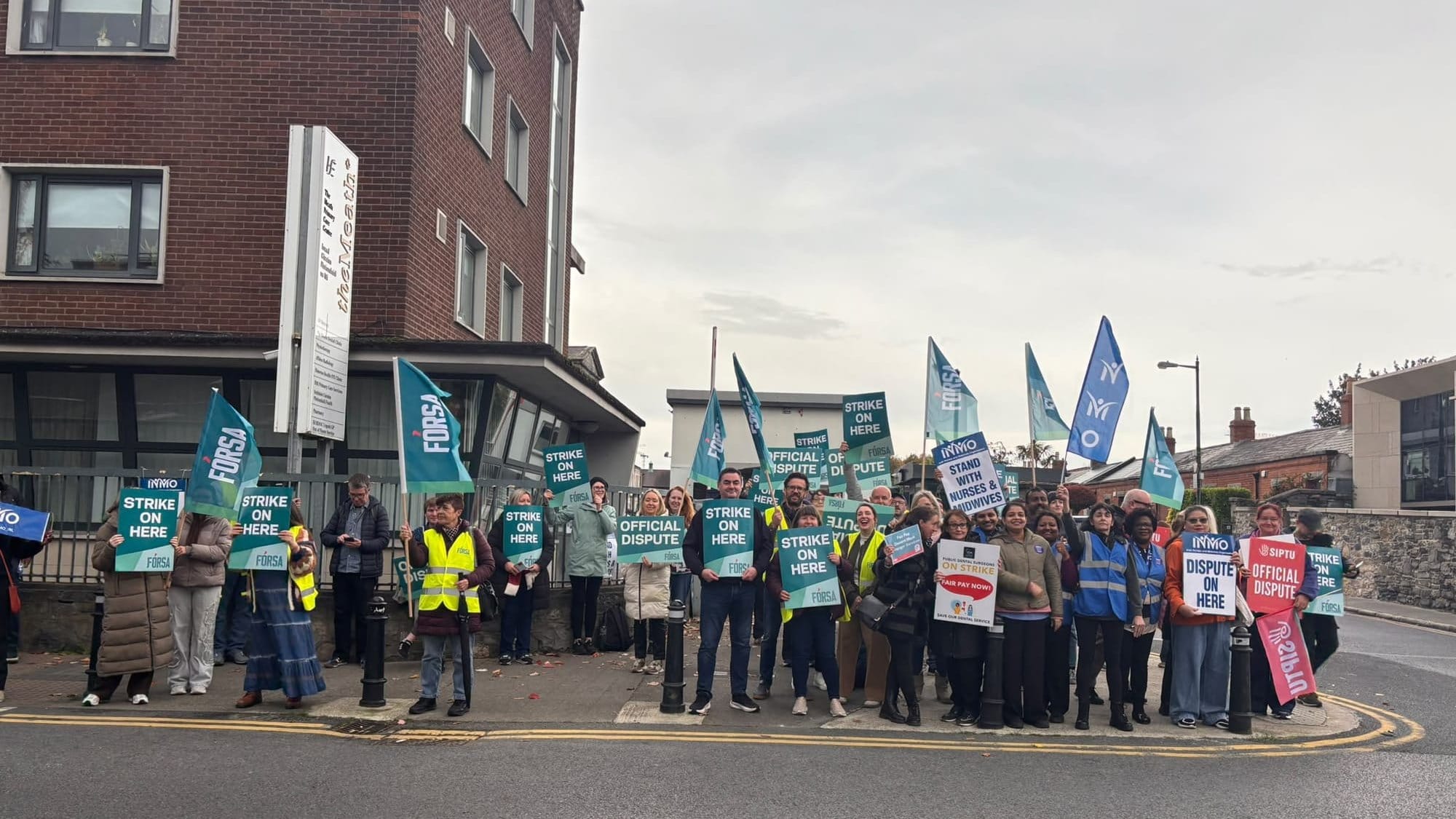
Unions have gone into talks without any kind of pay offer on the table. There is no guarantee from the Government that inflation busting pay increases will be delivered. At this point we need to be clear about what would be an acceptable deal as the union leaders have not said what they are actually looking for.
At a bare minimum workers need 10% now. The money is there to pay for this.
What Do Workers Need?
Real pay increase are needed. The facts are simple:
- Between 2021 & 2025 public sector wages fell behind inflation by 5.5%.
- In 2026 workers got 2% for the first half of the year: inflation is now 4.1%
- Inflation will be at least 3% next year.
Workers need at least 10% for the next year just to catch up and stay ahead. But they need more.
They need compensation for 2026 and also protection against future jumps in inflation. There is no guarantee that inflation next year will stay at 3%. Indeed, the Central Bank warned in June it could be almost 5% in a severe scenario. Any pay deal must include an escalator clause if inflation goes up.
Why Do Workers Need This?
Everything is going up leading to cuts in real pay. Inflation was running at 4.1% in September, the fastest rate in nearly 3 years and far ahead of the 3.4% predicted by the Central Bank for 2026. The basics are through the roof in the last year.
And that’s not all. Like-for-like grocery prices rose 4.3% in the 12 weeks to 11 September ending four consecutive months of easing. We have the second most expensive food prices in the Eurozone and the third highest in the EU. No wonder Barnardo’s report that nearly half of parents are cutting back on meals in order to feed their children.
New rents are up nearly 8% in the last year. On top of that the Government has announced fare increase for public transport of up to 30%. This is a further burden for workers forced to commute long distances because of the housing crisis.
Workers Budget?
The so-called workers' budget did not deliver. As Conor Pope put it in the Irish Times “almost nobody will be better off in 2027” despite the Budget. He estimates average household will be €2000 worse off next year wiping out any gains of the Budget. A family spending €200 a week on groceries will be €450 worse off next year.
For a married couple with 2 children with one income of €50,000 the increase in take home pay will be 0.8% as a result of the budget. A single worker on €40,000 is 0.6% better off.
The Money Is There
The Government has provided €1.2 billion in the budget for pay increases. The money will be used to address all remaining elements of both the last public service agreement, which expired at the end of June, and any successor pay deal in 2027. "This includes the cost of any associated pension impacts," according to the Department of Public Expenditure.
So the figure for 2027 is much less than €1.2b. This is far from what is needed. It could mean a pay increase as low as 2% in in 2027. Effectively a pay cut. A 10% increase will cost €3b. The money is there.
- The government will run a budget surplus of €6.7b in 2026 and another €9.6b in 2027.
- The last budget saw a handout of €1.2b (full year cost) given to developers and highly profitable fast-food chains. We could take that back.
- The rich are getting richer. A report from the ERSI this week showed wealth in 2023 was two and a half times higher than a decade earlier at €927b and the top 10% own 50% of it. The ESRI shows a modest wealth tax of 1% on wealth over €2b and excluding the family home would yield €1.3b. Increase that to 3% and update to 2026 and you get over €4b. Oxfam’s more radical wealth tax would yield €9b
- Finally, employers like to give out about the public sector and how the workers are feather-bedded. But while Irish workers’ pay above average PRSI contributions in the EU, Irish employers are paying less in PRSI contributions than most EU counterparts. If they were to pay on a par with other countries, we could raise over €6b.
So it's clear the money is there. If last Wednesday's showed anything, it is that public sector workers make this country function. It showed the hidden work done by cleaners, porters and catering staff as well as the very visible work of teachers, SNAs, nurses and other health workers. We need to acknowledge the importance of this work by paying them properly.
Our task now is to raise expectations and ensure the great energy shown on Wednesday is used to deliver a real deal. Workers need to send a clear message to their union leaders that any deal that does not deliver will not be accepted. Don’t put the placards away yet.